LabubaRAT anti-analysis features
LabubaRAT is a Remote Access Tool (RAT) implemented in Rust. It was discovered and analyzed by two researchers at Blackpoint Cyber’s Adversary Pursuit Group.
Usually, when there’s one technical analysis, people tend to think it’s “enough”. In reality, in complex malware such as this one, there are always several different angles to look into and that can’t be covered in a single blog post.
In this blog post, I am going to cover techniques the malware author used to deceive the analyst.
Sample SHA256: b7443b0ab48d2f5786d1b6f3a580f02621e9ae5a3877ee3a44e01df13d984328
No malloc / free
In the main function of the RAT - and mostly everywhere in the binary - we see numerous calls to GetProcessHeap(), or HeapFree() etc.
| |
This is because this Rust binary was compiled without linking to msvcrt (Microsfot Visual C++ Runtime). Consequently, the binary does not have the standard malloc / free allocators, and Rust uses the OS’s heap API directly.
In this case, the binary was compiled for Windows MSVC. Rust uses the Windows Heap API (GetProcessHeap, HeapAlloc, HeapFree…). Those calls appear any time Rust code uses things like Box<T>, Vec<T> or String which all allocate on the heap.
Ok. But why? Actually, this is a deliberate anti-analysis technique because it’s impossible to hook
mallocorfree- which is what typical EDR or security products would attempt to do to track allocations. Any tool hookingmallocorfreewon’t see anything special.
Confusing Anti-VM feature
One of the first calls the main does appear to be an anti-VM function. Precisely, it calls first what looks like a wrapper (0x14067ed60), which in turn calls the anti-VM function (0x14067e530), that I named init_sandbox_regex.
From assembly, the re-constructed code (written in Rust) looks like this:
| |
You will certainly notice the regex pattern, like container|docker|kubernertes which are perfect to detect if the binary is running in a virtual environment or not.
Except many things are wrong and don’t make sense. Have you noticed them?
A regex such as gpu|cuda|cudnn detects the host has a GPU or CUDA. If this is the case, this is probably not a virtual environment, but a real hardware. Same for the nvidia or the fan patterns. Reciprocally, the IP address pattern can be used to detect test/virtual environments (127.0.0.1 etc). So, we have regex that match positively VM while other match it negatively. Yet, all patterns are grouped in a single set and matched together with is_match. With is_match, the result is a boolean: there is no way to say “our string matches only those patterns”. Conclusion: the pattern set is weird.
Next, the line regex_set.is_match("probe_init") does not make sense either: we will always be matching the same hard coded string, probe_init, against our list of patterns. The result is fixed and will always be false.
So, we inspect the caller of init_sandbox_regex. The decompiled code is very short… too short! That’s because Ghidra (12.1.2) messes it up. A memcpy helper function (0x140677e40) had been marked as no-return. When Ghidra followed the call, it assumed execution never continued past it, and consequently never decompiled the code after the call.
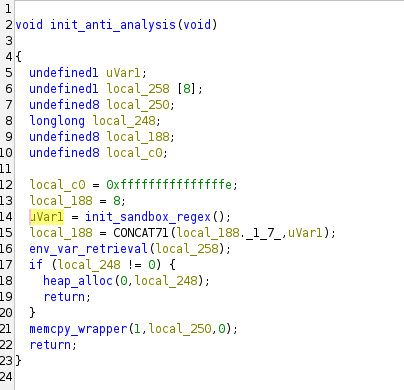
The solution is to clear the no-return flag for the memcpy helper function, then delete and re-create the function.
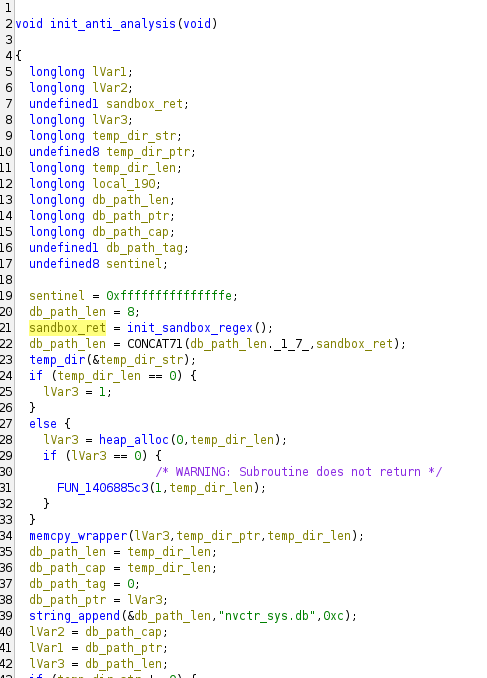
We see that init_sandbox_regex() returns a boolean in sandbox_ret. This value is then stored in db_path_len (does not make sense) and finally overwritten later. Indeed, std::env::temp_dir returns a temporary directory, and to that, the code appends nvctr_sys.db.
So, the return value of init_sandbox_regex() is never used. It’s dead code, either left there by some bad copy/paste, or intentionally left there to confuse the analyst (I confirm it confused me…).
Verdict. There is absolutely no VM/sandbox detection at all, the entire point of the function is to create the absolute path for the config database
nvctr_sys.db.
Time check
Later, the LabubaRAT main function shows the following code:
| |
GetSystemTimePreciseAsFileTime get the current date. This is compared with a constant, 0x19db1ded53e8000 which corresponds to Nov 20, 2031.
If the current date is before that date - this is the expected situation - we go in the if and use a constant lVar16. If the date is greater (the malware author probably wants to detect this abnormal situation), another constant is computed.
From the current process id, the lVar16 value and the current date, a seed is computed. Using a different constant when the date is abnormal ensures the seed is of a different nature in that case, and consequently for example, that subsequent decryption will fail.
This is a time check function.
Anti-Debug
After generating the seed, the code calls IsDebuggerPresent().
| |
If a debugger is indeed present, the code will go into an infinite loop (causing the analyst difficulty to debug and stop the process).
This is basic but effective debugger detection code.
Conclusion
The sample has exhibited:
- Anti-analysis with no malloc/free
- Dead code looking like anti-VM, potentially left to confuse the analyst, or just by error
- Time check
- Anti-debug
If you like reverse engineering, there is (nearly) always more to say on a sample which has already been analyzed. Look into it. You’ll learn lots of assembly tricks, and also in this case, Rust specificities.
– Cryptax