GoGra Linux Dropper analysis
GoGra is an backdoor family which emerged in 2024, mostly targeting India and Afghanistan. In April 2026, its developers released a Linux variant, which was analyzed here. In this blog post, we’ll go over a few interesting functionalities which were not detailed in that prior analysis.
IOC: 9c23c65a8a392a3fd885496a5ff2004252f1ad4388814b20e5459695280b0b82
Background info
GoGra was first seen in November 2023. It is written in Go and abuses the Microsoft Graph API.
Microsoft Graph API is a REST API to access Office 365 resources. GoGra uses it to communicate via emails to a C2. This is smart for many reasons:
- The malicious communication to the C2 occurs through a legitimate protocol, Graph API. It is consequently difficult to spot and to block.
- It’s a dead drop: the bots don’t know who is the attacker. They use a mailbox to deposit information and read commands. The person who orchestrates the attacks is unknown, and may change over time.
- To log on the Outlook account, the bots use an OAuth2 token. Consequently, the email address the account corresponds to is unknown and cannot be used as an IOC.
GoGra is attributed to the Harvester APT group, which has been active since 2021. GoGra is probably inspired from Graphon, a .NET backdoor also written by the Harvester group.
| Date | Event |
|---|
| June 2021 | Harvester first observed, using Graphon (.NET backdoor abusing Graph API) |
| Nov 2023 | GoGra first discovered — Windows Go backdoor against a South Asia media org |
| Apr 22, 2026 | Linux GoGra variant |
The differences between the initial Windows variant of GoGra and the Linux variant are listed in a table here: they are quite minor.
| Feature | Graphon (2021) | GoGra Windows (2024) | GoGra Linux (2026) |
|---|
| Language | .NET | Go | Go |
| Platform | Windows | Windows | Linux |
| Inner package | N/A | NEWCLIENT/services | OUTLOOKCLIENT/services |
| C2 channel | Microsoft Graph API | Microsoft Graph API | Microsoft Graph API |
| Mailbox folder | N/A | “Dragan Dash” | “Zomato Pizza” |
| Command exec | cmd.exe | cmd.exe | /bin/bash -c |
| Beacon interval | N/A | 5 min (on HTTP 204) | 2 seconds |
| AES-256-CBC key | b14ca5898a4e4133bbce2ea2315a1916 | b14ca5898a4e4133bbce2ea2315a1916 | b14ca5898a4e4133bbce2ea2315a1916 |
The attack chain for GoGra is the following:
- The victim receives a file which poses as a PDF file.
- In reality, the file is not a PDF but an ELF binary, a dropper.
- The dropper fetches within itself another embedded binary, the payload.
- The payload is immediately executed, while a decoy PDF is displayed.
embed.FS is a read-only type in Go’s embed package. It allows entire directories or multiple filed to be embedded in a Go binary at compile time.
1
2
3
4
5
6
7
8
9
| type FS struct {
files *[] file // pointer to a slice of file entries
}
type file struct {
name string // ptr + len
data string
hash [16] byte
}
|
In the binary, the structure is found at address 0x76ee20 (virtual address 0xb6ee20 in Ghidra):

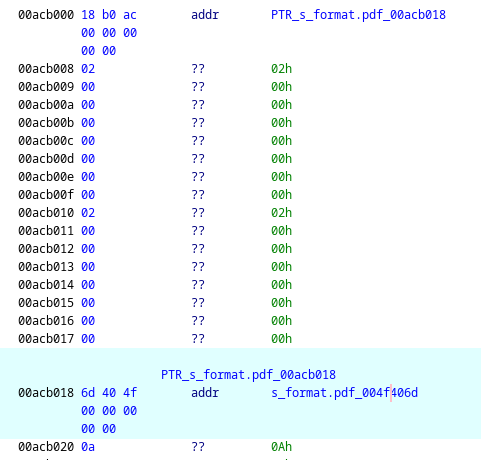
So, the file entries are at 0x00acb000. If we jump at that address, we get the address of a pointer to the file name at 0x00acb018. That address points to 0x004f406d. After the pointer, note the presence of the length of the filename: 0x0a (10).
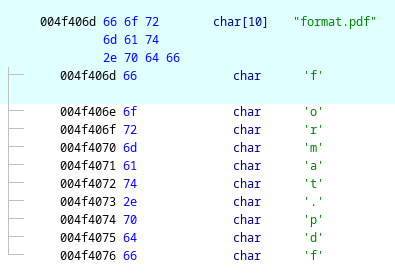
Finally, we get the name of the file which is embedded (that’s the filename on the host of the malware developer): format.pdf (10 characters).
We can script a quick program to read the embedded files:
 1
 2
 3
 4
 5
 6
 7
 8
 9
10
11
12
13
| import struct
with open('gogra.elf', 'rb') as f:
f.seek(0xacb018 - 0x400000)
for i in range(2):
entry = f.read(48)
name_ptr, name_len = struct.unpack('<QQ', entry[0:16])
data_ptr, data_len = struct.unpack('<QQ', entry[16:32])
hash_val = entry[32:48]
f.seek(name_ptr - 0x400000)
name_str = f.read(name_len).decode('utf-8')
f.seek(save_pos)
print(f'file[{i}]: name="{name_str}" (ptr=0x{name_ptr:08x}, len={name_len}), data=0x{data_ptr:08x} len={data_len}, hash={hash_val[:4].hex()}...')
|
There are 2 embedded files. The first one, format.pdf, is the PDF decoy, the second one, main, is the ELF payload.
1
2
| file[0]: name="format.pdf" (ptr=0x004f406d, len=10), data=0x004fdee0 len=31769, hash=e8114d6a...
file[1]: name="main" (ptr=0x004f3478, len=4), data=0x00505b00 len=5902520, hash=e2f8b227...
|
Lazier approach: we can ask a LLM to write a Ghidra script that will extract all embedded files (source code in Appendix A). In Ghidra, we open the Script Manager, Run and select the script.
 1
 2
 3
 4
 5
 6
 7
 8
 9
10
11
12
13
14
15
16
17
| ExtractPayload.java> Running...
[*] ExtractPayload: embed.FS at VA 0xb6ee20
[*] embed.FS.files ptr = 0xacb000
[*] File table: data=0xacb018 len=2 cap=2
[*] Entry 0: name='format.pdf' data=0x4fdee0 size=31769 hash=e8114d6a18220998a1546cbbd633ce52
[*] Read 31769 / 31769 bytes from VA 0x4fdee0
[+] Written to: ./artifacts/format.pdf
[+] File type: PDF (decoy?)
[*] Entry 1: name='main' data=0x505b00 size=5902520 hash=e2f8b227e8b1046921acfd15acd06f32
[*] Read 5902520 / 5902520 bytes from VA 0x505b00
[+] Written to: ./artifacts/main
[+] File type: ELF executable
[*] Done.
ExtractPayload.java> Finished!
|
| Filename | Description | Region |
|---|
format.pdf (this sample) | Indian MoEA briefing memo, EAM France/Luxembourg visit, Dec 2025 | India |
TheExternalAffairesMinister.pdf | Misspelling of “Affaires” — EAM document | India |
Details Format.pdf | Generic document filename | India |
| “Zomato Pizza” | Fake food delivery lure (Zomato = popular Indian delivery service) | India |
umrah.pdf | Islamic pilgrimage to Mecca document | Afghanistan |
Juicy part no. 2: how the files are displayed / executed
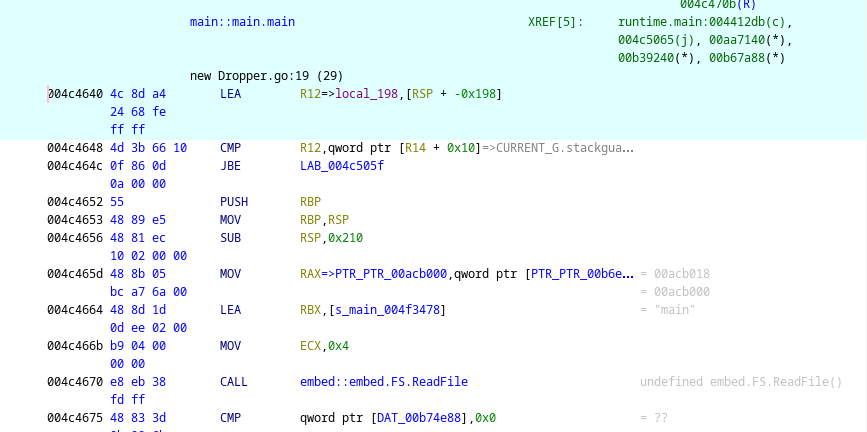
With the 2 files, the main (0x4c465d) (source code name Dropper.go) does the following:
embed.FS.ReadFile(“main”) - reads the payload into memorymain.DropEmbeddedFile (0x4c5960)
2.1 embed.FS.ReadFile(“format.pdf”) - reads the decoy PDF in memory
2.2 os.OpenFile with O_WRONLY|O_CREATE and perms=777, which actually writes the PDF in the current directory
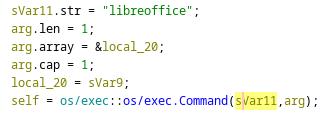
2.3 main.OpenFile (0x4c5c20): runs LibreOffice on the PDF, to display it and deletes the file in the end.main.filedroping (0x4c5080): drops the payload, chmod +x and executes it with exec.Start()
Don’t trust blindly your LLM. At some point, I asked my LLM to produce source code matching main.OpenFile. It gave me this:
 1
 2
 3
 4
 5
 6
 7
 8
 9
10
11
12
13
14
15
16
17
18
19
| // OpenFile executes the previously dropped payload at <cwd>/<name>.pdf,
// waits for it to finish, captures and prints its output, then removes
// the file from disk.
//
// The name "OpenFile" is a deliberate misdirection — it does not open
// a file for reading; it executes it.
//
// param name: base filename (without extension), same value passed to DropEmbededFile.
func OpenFile(name string) {
// 1. Reconstruct full path of the dropped payload
cwd, _ := os.Getwd()
payloadPath := cwd + "/" + name + ".pdf"
fmt.Println(payloadPath) // logged
// 2. Execute the payload and capture output
// os.exec.Command(payloadPath) — no arguments passed
// A new bytes.Buffer is allocated and wired to cmd.Stdout
cmd := exec.Command(payloadPath)
...
|
LLM’s analysis is wrong: it’s not the payload that is executed by LibreOffice.
The LLM assumed a payload would executed - which makes sense in malware analysis - and invented a speech about OpenFile name being a “deliberate misdirection”. When we analyze malware, we tend to be paranoid, so this could have been plausible. But it’s not the reality: this function is called for the decoy PDF, it calls LibreOffice to open it and then deletes the file.
How can we spot such errors from LLMs? My advice is (1) to cross examine everything a LLM says, and (2) to ask different LLMs, with different contexts, and see if they come up to the same conclusion…
Juicy part no.3: How the malware handles persistance
The embedded payload “main” is written to ~/.config/systemd/user/userservice and a user systemd service (userservice.service) is created to restart on failure or reboot. The service configuration contains:
1
2
3
4
5
6
7
8
| [Unit]
Description=Foo
[Service]
ExecStart=/home/<user>/.config/systemd/user/userservice
Restart=always
Restart=on-failure
[Install]
WantedBy=default.target
|
Note the service description is suspicious: “Foo”. IMHO it is a bad choice for a name.
The service is enabled via the command systemctl --user enable userservice.
In addition to system services, the malware also deploys XDG autostart. XDG autostart is a mechanism to start applications in a Window Manager - it will only work for GUI logins. The malware creates a configuration file ~/.config/autostart/abc.desktop with this content:
1
2
3
4
| [Desktop Entry]
Type=Application
Name=conky
Exec=/home/<user>/.config/systemd/user/userservice
|
The name is better chosen this time: Conky is desktop system monitor.
  1
  2
  3
  4
  5
  6
  7
  8
  9
 10
 11
 12
 13
 14
 15
 16
 17
 18
 19
 20
 21
 22
 23
 24
 25
 26
 27
 28
 29
 30
 31
 32
 33
 34
 35
 36
 37
 38
 39
 40
 41
 42
 43
 44
 45
 46
 47
 48
 49
 50
 51
 52
 53
 54
 55
 56
 57
 58
 59
 60
 61
 62
 63
 64
 65
 66
 67
 68
 69
 70
 71
 72
 73
 74
 75
 76
 77
 78
 79
 80
 81
 82
 83
 84
 85
 86
 87
 88
 89
 90
 91
 92
 93
 94
 95
 96
 97
 98
 99
100
101
102
103
104
105
106
107
108
109
110
111
112
113
114
115
116
117
118
119
120
121
122
123
124
125
126
127
128
129
130
131
132
133
134
135
136
137
138
139
140
141
142
143
144
145
146
147
148
149
150
151
152
153
| import ghidra.app.script.GhidraScript;
import ghidra.program.model.address.*;
import ghidra.program.model.mem.*;
import java.io.*;
import java.nio.file.*;
public class ExtractPayload extends GhidraScript {
// embed.FS global VA
static final long EMBED_FS_VA = 0xb6ee20L;
// embed.file entry size
static final int EMBED_FILE_SIZE = 48;
// Where to write extracted files
static final String OUTPUT_DIR = "./artifacts";
@Override
public void run() throws Exception {
Memory mem = currentProgram.getMemory();
AddressFactory af = currentProgram.getAddressFactory();
Files.createDirectories(Paths.get(OUTPUT_DIR));
printf("[*] ExtractPayload: embed.FS at VA 0x%x\n", EMBED_FS_VA);
// ----------------------------------------------------------------
// Step 1: Read embed.FS.files pointer
// ----------------------------------------------------------------
Address fsAddr = af.getAddress(String.format("0x%x", EMBED_FS_VA));
long slicePtr = readU64(mem, fsAddr);
printf("[*] embed.FS.files ptr = 0x%x\n", slicePtr);
if (slicePtr == 0) {
printf("[!] embed.FS.files is nil — no embedded files found.\n");
return;
}
// ----------------------------------------------------------------
// Step 2: Read slice header {data ptr, len, cap}
// ----------------------------------------------------------------
Address sliceAddr = af.getAddress(String.format("0x%x", slicePtr));
long dataPtr = readU64(mem, sliceAddr);
long length = readU64(mem, sliceAddr.add(8));
long capacity = readU64(mem, sliceAddr.add(16));
printf("[*] File table: data=0x%x len=%d cap=%d\n", dataPtr, length, capacity);
if (length == 0 || length > 1000) {
printf("[!] Suspicious file count (%d), falling back to string search.\n", length);
return;
}
// ----------------------------------------------------------------
// Step 3: Iterate embed.file entries
// ----------------------------------------------------------------
for (long i = 0; i < length; i++) {
long entryVA = dataPtr + i * EMBED_FILE_SIZE;
Address entryAddr = af.getAddress(String.format("0x%x", entryVA));
long namePtr = readU64(mem, entryAddr);
long nameLen = readU64(mem, entryAddr.add(8));
long filePtr = readU64(mem, entryAddr.add(16));
long fileLen = readU64(mem, entryAddr.add(24));
// Read hash (16 bytes) for display
byte[] hashBytes = new byte[16];
mem.getBytes(entryAddr.add(32), hashBytes);
String hashHex = bytesToHex(hashBytes);
// Decode name string
String name = "(invalid)";
if (namePtr != 0 && nameLen > 0 && nameLen < 512) {
byte[] nameBytes = new byte[(int) nameLen];
mem.getBytes(af.getAddress(String.format("0x%x", namePtr)), nameBytes);
name = new String(nameBytes, "UTF-8");
}
printf("\n[*] Entry %d: name='%s' data=0x%x size=%d hash=%s\n",
i, name, filePtr, fileLen, hashHex);
// Skip directory entries
if (name.endsWith("/") || fileLen == 0 || filePtr == 0) {
printf(" [*] Directory or empty entry, skipping.\n");
continue;
}
extractFile(mem, af, name, filePtr, fileLen);
}
printf("\n[*] Done.\n");
}
// ----------------------------------------------------------------
// Write fileLen bytes starting at fileVA to OUTPUT_DIR/<safeName>
// ----------------------------------------------------------------
private void extractFile(Memory mem, AddressFactory af,
String name, long fileVA, long fileLen) throws Exception {
Address dataAddr = af.getAddress(String.format("0x%x", fileVA));
byte[] content = new byte[(int) fileLen];
int bytesRead = mem.getBytes(dataAddr, content);
printf(" [*] Read %d / %d bytes from VA 0x%x\n", bytesRead, fileLen, fileVA);
// Sanitize filename for output
String safeName = name.replace("/", "_").replace("..", "_");
if (safeName.isEmpty()) safeName = "extracted_payload";
Path outPath = Paths.get(OUTPUT_DIR, safeName);
Files.write(outPath, content);
printf(" [+] Written to: %s\n", outPath.toAbsolutePath());
// File type hint
if (bytesRead >= 4) {
String magic = bytesToHex(java.util.Arrays.copyOf(content, 4));
if (content[0] == 0x7f && content[1] == 'E' && content[2] == 'L' && content[3] == 'F') {
printf(" [+] File type: ELF executable\n");
} else if (content[0] == 'M' && content[1] == 'Z') {
printf(" [+] File type: PE/MZ executable\n");
} else if (content[0] == '%' && content[1] == 'P' && content[2] == 'D' && content[3] == 'F') {
printf(" [+] File type: PDF (decoy?)\n");
} else {
printf(" [+] File magic: %s\n", magic);
}
}
}
// ----------------------------------------------------------------
// Helpers
// ----------------------------------------------------------------
private long readU64(Memory mem, Address addr) throws MemoryAccessException {
byte[] b = new byte[8];
mem.getBytes(addr, b);
long v = 0;
for (int i = 7; i >= 0; i--) {
v = (v << 8) | (b[i] & 0xFFL);
}
return v;
}
private byte[] longToLE(long v) {
byte[] b = new byte[8];
for (int i = 0; i < 8; i++) {
b[i] = (byte)(v & 0xFF);
v >>= 8;
}
return b;
}
private String bytesToHex(byte[] bytes) {
StringBuilder sb = new StringBuilder();
for (byte b : bytes) sb.append(String.format("%02x", b));
return sb.toString();
}
}
|
Appendix B: LLM’s reconstruction of dropper’s main source code
Warning: this is not the real source code, but what the LLM assumed the source code probably looks like.
 1
 2
 3
 4
 5
 6
 7
 8
 9
10
11
12
13
14
15
16
17
18
19
20
21
22
23
24
25
26
27
28
29
30
31
32
33
34
35
36
37
38
39
40
41
42
43
44
45
46
47
48
49
50
51
52
53
54
55
56
57
58
59
60
61
62
63
64
65
66
67
68
69
70
71
72
73
74
75
76
77
78
79
80
81
82
| package main
import (
"fmt"
"os"
"os/exec"
"os/user"
)
func main() {
// Drop the embedded payload binary to disk and open/execute it
DropEmbededFile()
// Get current user info to build home-directory paths
currentUser, err := user.Current()
if err != nil {
fmt.Println(err)
return
}
username := currentUser.Username
homeDir := currentUser.HomeDir
fmt.Println(username)
configDir := homeDir + "/.config"
// Check if ~/.config/systemd/user/ exists
systemdUserDir := configDir + "/systemd/user"
_, statErr := os.Stat(systemdUserDir)
if os.IsNotExist(statErr) {
// systemd/user directory does not exist — create it
fmt.Println("does not exist, systemd user is absent")
fmt.Println(homeDir)
mkdirCmd := exec.Command("mkdir", systemdUserDir)
if err := mkdirCmd.Run(); err != nil {
fmt.Println(err)
}
fmt.Println("systemd created")
// After creating systemd dir, install the service file
// Then check/create userservice unit
userservicePath := systemdUserDir + "/userservice"
_, statErr2 := os.Stat(userservicePath)
if os.IsNotExist(statErr2) {
fmt.Println("does not exist, systemd user is absent")
// Enable the service
enableCmd := exec.Command("systemctl", "--user", "enable", "userservice")
if err := enableCmd.Run(); err != nil {
fmt.Println(err)
}
fmt.Println("systemctl enable done")
// Drop service file and launch payload
filedroping()
CreateServiceFile()
} else {
CreateServiceFile()
}
} else {
// systemd/user directory exists — use XDG autostart fallback
fmt.Println("exists")
autostartDir := configDir + "/autostart"
_, statErr2 := os.Stat(autostartDir)
if os.IsNotExist(statErr2) {
// autostart dir missing — create it then install desktop entry
fmt.Println("autostart dir missing, creating")
mkdirCmd := exec.Command("mkdir", autostartDir)
if err := mkdirCmd.Run(); err != nil {
fmt.Println(err)
}
fmt.Println("autostart created")
creatingDesktopfile(homeDir)
} else {
// autostart dir already exists — just install desktop entry
creatingDesktopfile(homeDir)
}
}
}
|