CTE v2 (2026) - Toujours en Vente
This is a reverse engineering challenge created by Miaou for Capture The Evidence (CTE) in June 2026. We are given a binary broker_tool, and we need to find a URL to flag, e.g https://u.rl/path.
Reconnaissance
The binary is an ELF x86-64, not stripped.
We run it:
 1
 2
 3
 4
 5
 6
 7
 8
 9
10
11
12
13
14
| ===================================
B U S I N E S S P O R T A L
===================================
Welcome, valued partner.
Remember: data is our business. And business is GOOD.
1. Submit Email Lists
2. Submit Leaked Photos
3. Submit Leaked Documents
4. Bug Report
q. Quit
Choose:
|
The fourth menu requires a password, we’ll concentrate on this one.
1
2
3
| you need the password to unlock this menu
PRESS ENTER TO MENU
|
Reverse engineering the binary with Ghidra
This binary was implemented in Rust. You’ll spot plenty of Rust names: __rust_begin_short_backtrace(), __rustcall {{closure}}() etc.
More? Read my talk on reversing Rust with Radare2 at r2con 2025.
Rust comes with lots of its own functions. Notice the namespace called ToujoursEnVente: that’s where our application functions lie.
| Function name | Address | Description |
|---|
ToujoursEnVente::main | 0x119df0 | Infinite menu loop |
ToujoursEnVente::validate_password | 0x118ec0 | Validates password for option 4 |
ToujoursEnVente::decrypt | 0x11a120 | Decrypts a ciphertext |
ToujoursEnVente::bug_report | 0x118150 | Called for option 4 |
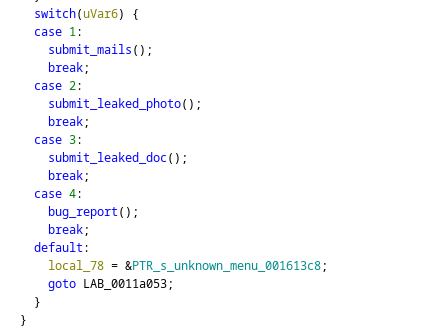
The menu loop is handled by ToujoursEnVente::main and calls bug_report() when we select option 4.

bug_report reads an environment variable ADMIN_PWD from which it validates a password:
1
2
3
4
| std::env::_var(&env_var_result,
"ADMIN_PWDlibrary/std/src/../../backtrace/src/symbolize/gimli/elf.rs",9);
if (env_var_result == 0) {
validate_password(pwd_valid,pwd_cap,pwd_len);
|
This password is later used to decrypt a ciphertext:
1
2
3
| lVar1 = CONCAT44(uStack_4c,decoded_output);
data_ptr = (byte *)CONCAT44(uStack_44,uStack_48);
decrypt(&decrypt_buf,data_ptr,decoded_len);
|
Understanding validate_password
The function is quite ugly to reverse: I’ll use OpenCode + Ghidra MCP and a free model to make some sense out of it. Basically, the password is validated against a list of constraints, and each failed constraint produces a different error message.
The constraints are not easy to reverse. See for yourself, this is checking that bytes are not >= 0x80:
 1
 2
 3
 4
 5
 6
 7
 8
 9
10
11
12
13
14
15
16
17
| 00118ee0 48 8d 48 20 LEA RCX,[RAX + 0x20]
00118ee4 4c 39 f1 CMP RCX,R14
00118ee7 77 2b JA LAB_00118f14
00118ee9 48 83 f8 e0 CMP RAX,-0x20
00118eed 0f 84 a7 JZ LAB_0011909a
01 00 00
00118ef3 f3 41 0f MOVDQU XMM0,xmmword ptr [R15 + RAX*0x1]
6f 04 07
00118ef9 f3 41 0f MOVDQU XMM1,xmmword ptr [R15 + RAX*0x1 + 0x10]
6f 4c 07 10
00118f00 66 0f eb c8 POR XMM1,XMM0
00118f04 66 0f d7 d1 PMOVMSKB EDX,XMM1
00118f08 48 89 c8 MOV RAX,RCX
00118f0b 85 d2 TEST EDX,EDX
00118f0d 74 d1 JZ LAB_00118ee0
00118f0f e9 86 01 JMP LAB_0011909a
00 00
|
The error messages are obfuscated and cannot be found by a simple string search.
Constraints:
- Each byte of the password must be between 0x20 and 0x7e
- Password length must be >= 16, and a multiple of 3 and 4 (so it must be a multiple of 12).
- The sum of all bytes must be divisible by 10
- An exclamation mark must be in the middle of the password
- Password must contain at least 1 lowercase, 1 uppercase, 1 digit and 1 character
! - The password must contain the string
paste!s d3 na74 3 b4c4lh4u as a subsequence, but not necessarily contiguous, i.e we can have p, then other bytes, then aste!s etc.
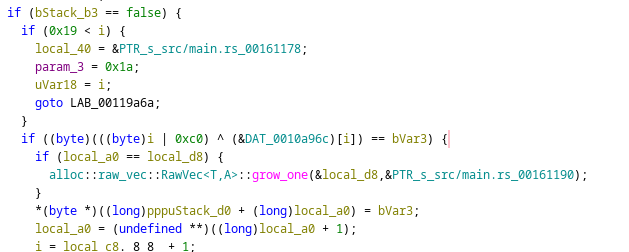
The string paste!s d3 na74 3 b4c4lh4u decodes from an encrypted table at 0x10a96c: STRING[i] = ENC_TABLE[i] ^ (i + 0xc0).
Finding the password with z3
The perfect solution to solve constraints is Z3: pip install z3 for support in Python.
After a few attempts (this is solver number 4), my AI model wrote the perfect solver:
  1
  2
  3
  4
  5
  6
  7
  8
  9
 10
 11
 12
 13
 14
 15
 16
 17
 18
 19
 20
 21
 22
 23
 24
 25
 26
 27
 28
 29
 30
 31
 32
 33
 34
 35
 36
 37
 38
 39
 40
 41
 42
 43
 44
 45
 46
 47
 48
 49
 50
 51
 52
 53
 54
 55
 56
 57
 58
 59
 60
 61
 62
 63
 64
 65
 66
 67
 68
 69
 70
 71
 72
 73
 74
 75
 76
 77
 78
 79
 80
 81
 82
 83
 84
 85
 86
 87
 88
 89
 90
 91
 92
 93
 94
 95
 96
 97
 98
 99
100
101
102
103
104
| #!/usr/bin/env python3
"""
Z3 solver for broker_tool password v4.
XOR is a SUBSEQUENCE match (26 bytes "paste!s d3 na74 3 b4c4lh4u").
'!' at position L/2, AFTER XOR completes.
L must be %12==0, L/2 > 25 → L > 50 → L >= 60.
"""
from z3 import *
XOR_TABLE = [
0xb0, 0xa0, 0xb1, 0xb7, 0xa1, 0xe4, 0xb5, 0xe7,
0xac, 0xfa, 0xea, 0xa5, 0xad, 0xfa, 0xfa, 0xef,
0xe3, 0xf1, 0xb0, 0xe7, 0xb7, 0xe1, 0xba, 0xbf,
0xec, 0xac
]
PREFIX = bytes(XOR_TABLE[i] ^ (i | 0xC0) for i in range(26))
def solve(L):
print(f"\n=== Trying L={L} ===")
s = Solver()
pw = [BitVec(f"c{i}", 32) for i in range(L)]
for i in range(L):
s.add(pw[i] >= 0x20, pw[i] <= 0x7e)
# XOR subsequence: PREFIX bytes must appear in order in the password
# First char must be 'p' (XOR[0])
s.add(pw[0] == PREFIX[0])
# Track XOR subsequence progress
# xp[i] = how many XOR bytes matched up to position i
xp = [Int(f"xp_{i}") for i in range(L)]
s.add(xp[0] == 1) # pw[0] == PREFIX[0] guaranteed above
for i in range(1, L):
match_next = Or([And(xp[i-1] == k, pw[i] == PREFIX[k]) for k in range(26)])
s.add(If(match_next, xp[i] == xp[i-1] + 1, xp[i] == xp[i-1]))
s.add(xp[i] >= 0, xp[i] <= 26)
# All 26 XOR bytes must be found
s.add(xp[L-1] == 26)
# '!' at middle position L/2
mid = L // 2
s.add(pw[mid] == ord('!'))
# Character class requirements
num_upper = Sum([If(And(pw[i] >= ord('A'), pw[i] <= ord('Z')), 1, 0) for i in range(L)])
num_lower = Sum([If(And(pw[i] >= ord('a'), pw[i] <= ord('z')), 1, 0) for i in range(L)])
num_digit = Sum([If(And(pw[i] >= ord('0'), pw[i] <= ord('9')), 1, 0) for i in range(L)])
s.add(num_upper >= 5)
s.add(num_lower >= 8)
s.add(num_digit >= 1)
# cStack_b0: password[i] == password[i+2] for i=0..L-3
pair_matches = Sum([If(pw[i] == pw[i + 2], 1, 0) for i in range(L - 2)])
s.add(pair_matches >= 7)
# local_af: password[i] == password[i-1] + 1 for i=1..L-1
inc_matches = Sum([If(pw[i] == pw[i - 1] + 1, 1, 0) for i in range(1, L)])
s.add(inc_matches >= 6)
# Sum % 10 == 0
s.add(Sum(pw) % 10 == 0)
print("Solving...")
if s.check() == sat:
m = s.model()
vals = [m[pw[i]].as_long() for i in range(L)]
pwd = ''.join(chr(v) for v in vals)
# Verify
upper = sum(1 for i in range(L) if chr(vals[i]).isupper())
lower = sum(1 for i in range(L) if chr(vals[i]).islower())
digit = sum(1 for i in range(L) if chr(vals[i]).isdigit())
inc = sum(1 for i in range(1, L) if vals[i] == vals[i-1] + 1)
pair = sum(1 for i in range(L-2) if vals[i] == vals[i+2])
total = sum(vals)
print(f"\nPassword (len={L}): {pwd!r}")
print(f"Sum: {total}, %10 = {total % 10}")
print(f"Upper: {upper} (≥5), Lower: {lower} (≥8), Digit: {digit} (≥1)")
print(f"Inc: {inc} (≥6), Pair: {pair} (≥7)")
print(f"Mid (pos{mid}): {pwd[mid]} (should be !)")
# Check XOR subsequence
xor_ok = True
xor_idx = 0
for i in range(L):
if xor_idx < 26 and vals[i] == PREFIX[xor_idx]:
xor_idx += 1
xor_ok = (xor_idx == 26)
print(f"XOR subsequence: {'OK' if xor_ok else f'FAIL (matched {xor_idx}/26)'}")
return pwd
else:
print(f"UNSAT")
return None
# Try various lengths
for L in [60, 72, 84, 96]:
pwd = solve(L)
if pwd:
print(f"\n*** FOUND: {pwd!r} ***")
break
|
Run it:
 1
 2
 3
 4
 5
 6
 7
 8
 9
10
11
12
13
| python3 solver4.py
=== Trying L=60 ===
Solving...
Password (len=60): 'pa$_0f0F~}~12Q2Q23no3 t@ !|@x!SC@1ste!s d3 na74 3 b4c4lh4u*'
Sum: 4430, %10 = 0
Upper: 5 (≥5), Lower: 19 (≥8), Digit: 16 (≥1)
Inc: 6 (≥6), Pair: 7 (≥7)
Mid (pos30): ! (should be !)
XOR subsequence: OK
*** FOUND: 'pa$_0f0F~}~12Q2Q23no3 t@ !|@x!SC@1ste!s d3 na74 3 b4c4lh4u*' ***
|
The admin password is 'pa$_0f0F~}~12Q2Q23no3 t@ !|@x!SC@1ste!s d3 na74 3 b4c4lh4u*. It’s a bit strange. We do recognize the end of pasteis and de nata e bacalhau, but the beginning makes no sense. This had me doubt… but it was correct!
Flag
Now, it’s easy to flag. Launch ADMIN_PWD='pa$_0f0F~}~12Q2Q23no3 t@ !|@x!SC@1ste!s d3 na74 3 b4c4lh4u*' ./broker_tool and select option 4:
 1
 2
 3
 4
 5
 6
 7
 8
 9
10
11
12
13
14
15
16
17
18
19
20
21
22
23
24
| Choose: 4
Hey! So you pretend you are an admin and found a bug?
This is a serious software developed by serious roxxors from the 1337 team of brokers from Fantasmas De Redes!!
After all, we have found so much value in what others thought were useless!
We will track data from closed companies (maybe you worked there?) and extract value using their client listings.
Completed with dark web data, like people that wouldn't pay ransoms to recover their encrypted data
(all of this because they could not prevent 1337 hackers from entering their poorly protected systems).
And we did all this by our selves.
So.
Do you REALLY, *REALLY* think that you found a bug?
Prepare everything because we will want details and proofs that their IS a bug...
Be able to reproduce the bug, know what YOU did or what is wrong with YOUR machine (poor CPU architecture? not enough RAM? slow connection?).
WE WANT TO SEE IT.
If you dare showing it to us, just come to https://t.me/+k1JCrVoDHN5lYTBk and we will see.
Adeus!
PRESS ENTER TO MENU
|
Our flag is https://t.me/+k1JCrVoDHN5lYTBk. This is the Telegram group of a fake cybercriminal group, created for the CTE.
Understanding decrypt, just for fun
The decrypt function is not a simple XOR. It uses SHA-256 with a counter to generate a keystream which is used as XOR-key.
1
2
3
4
5
| keystream = b''
for counter in range(64):
keystream += SHA-256(password || counter_BE32)
decrypted = ciphertext XOR keystream
|
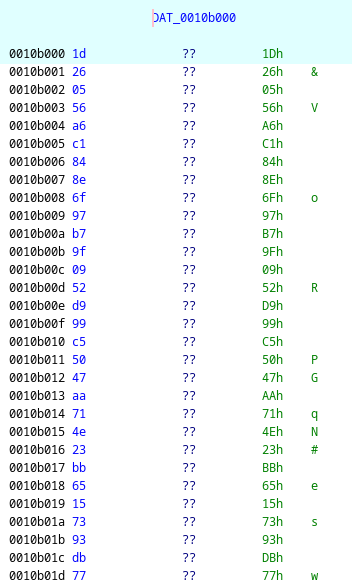
The ciphertext is located at 0x10b000
Understanding where the error messages are - just for fun
Previously, we said that each missed constraint in validate_password would display an error message, except these messages were obfuscated.
How are they obfuscated? This is of no use to flag the challenge, but I just wanted to know. Each error message consists in a static XoredLiteral struct with 3 fields:
- data_ptr: XOR-ed obfuscated bytes
- len
- key: the XOR key (a single byte)
| PTR_DAT | data_ptr | key | decrypted message |
|---|
0x1611a8 | 0x10a9b2 | 0x27 | there should be at least 1 symbol |
0x1611c0 | 0x10a9d3 | 0xa0 | ! should be placed in the middle |
0x1611d8 | 0x10a888 | 0x37 | there should be at least 1 digit |
0x1611f0 | 0x10aa21 | 0x14 | more chars must be the increment of the previous char (ABC...) |
0x161208 | 0x10aa5f | 0xb7 | more chars must be the same as the penultimate |
0x161220 | 0x10aa8d | 0xea | there are not enough upper case letter |
0x161238 | 0x10aab4 | 0xf4 | there are not enough lower case letters |
Conclusion
A lovely reverse challenge: I was very happy to use z3 + the decryption mechanism is interesting (not just a simple XOR as we often see).
Contrary to the official writeup, I did not use gdb.
– Cryptax